
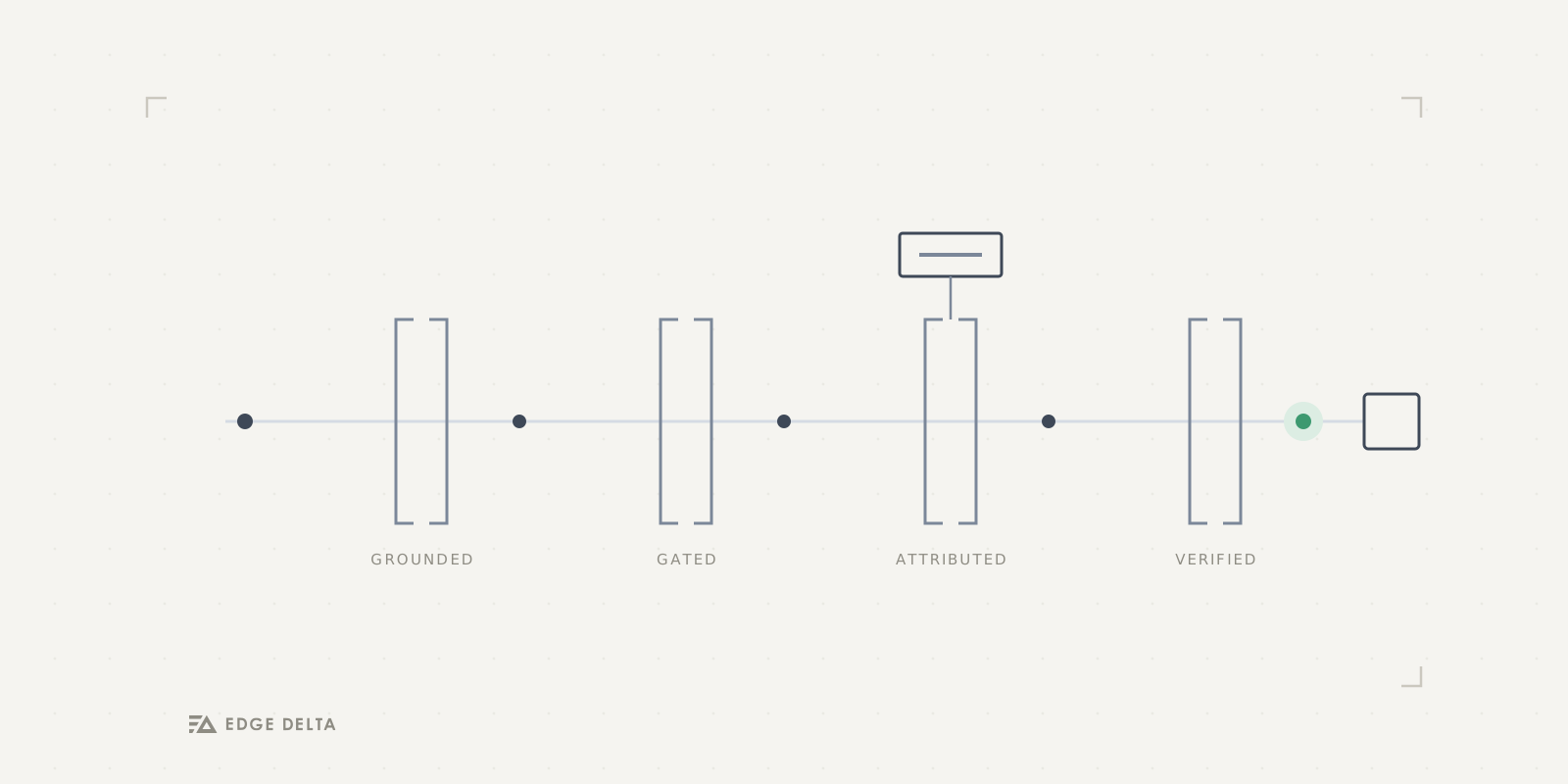
Autonomous AI agents are powerful in observability contexts because they can singlehandedly query telemetry, restart deployments, merge pull requests, and take countless other actions throughout the incident response process. But the same autonomy that makes them useful also makes them a serious liability when they’re not integrated properly. An agent that acts incorrectly or against a team’s wishes both creates more human work, and even worse, erodes trust in the system itself. That’s why it’s critical to build these agents so they never act ungrounded, ungated, or dishonestly.
At Edge Delta, we’ve built AI Teammates to operate within a highly structured, context-rich harness that strengthens their decision-making and eliminates unreliable behavior. In this post, we’ll walk through our approach, and demonstrate how it helps teams keep their production systems running.
The obvious approach
When agents simply receive a large list of tools to be called, two failure modes appear immediately: first, the model proposes actions it can’t actually perform (i.e., “I’ll merge the PR” when GitHub isn’t connected properly or when no merge tools exist in the org), and second, it proposes fixes before it understands the problem. This leaves human teams with no real way of knowing how valuable or accurate these agentic decisions are.
Grounding: search before you claim
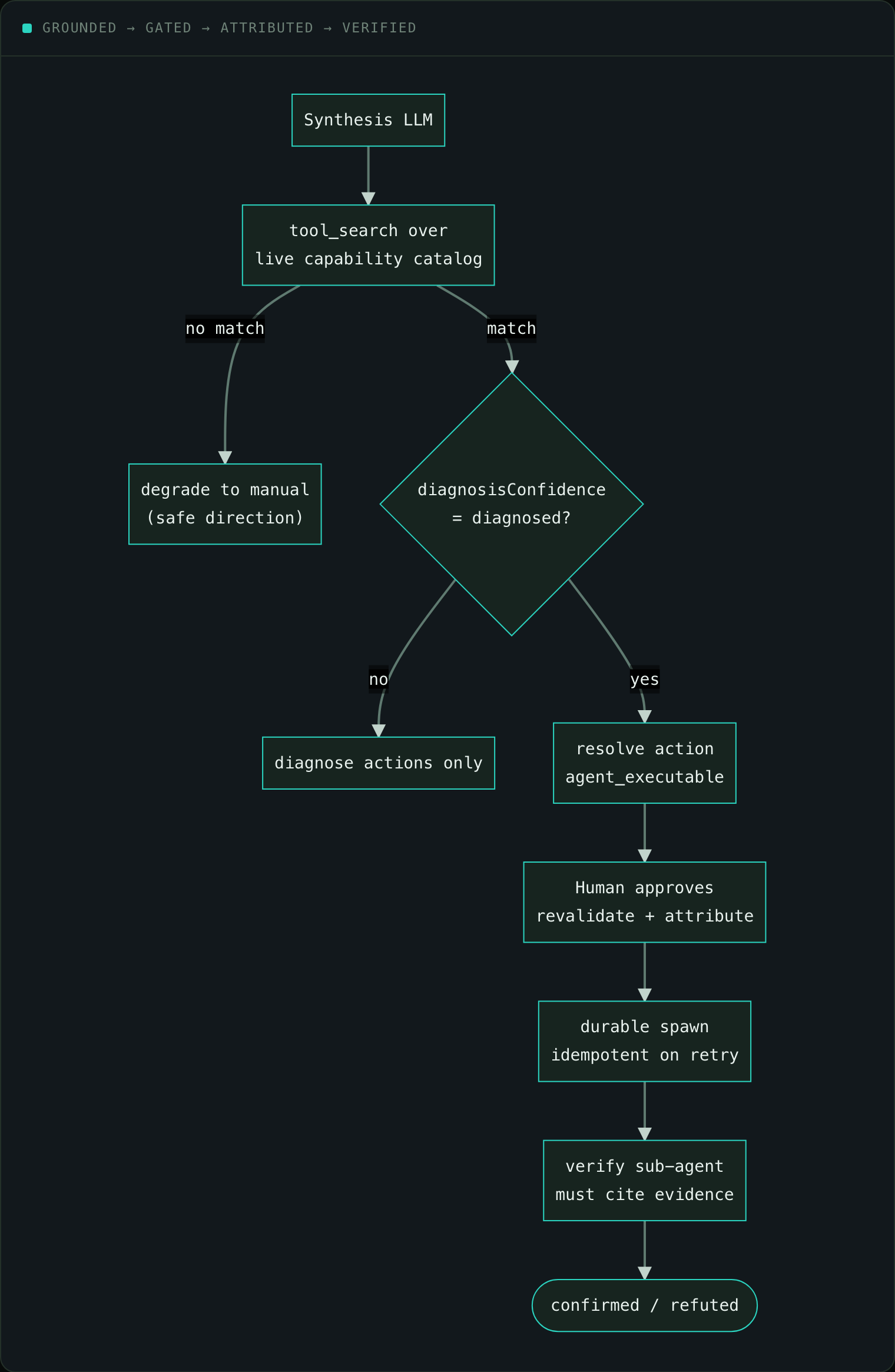
Instead of dumping every tool into the prompt, the synthesis step must search the org’s live, authenticated capability catalog before it can claim an action. We build that catalog from only the connectors the org has actually connected, load their real tool specs, and expose a tool_search the model queries with intent like “merge pull request.” If nothing matches, the tool returns “treat the action as manual / human-verified.” Anything that isn’t grounded degrades to manual (the safe direction), and we enforce that twice: at generation, and again in post-processing that strips any connector the org hasn’t connected (and forces telemetry-only “streaming” connectors, which can ingest but not act, to manual). Hallucinating a capability is the one failure that erodes all trust, so we’re deliberately redundant about it.
Gating and structure
Actions carry structure, and the structure is enforced by schema:
{
  category:            'resolve' | 'diagnose'
  execution.mode:      'manual' | 'agent_executable'
  requiredConnectorType?: string   // a connector that can ACT
  verifyConnectorType?:   string   // a connector that can OBSERVE the result
  targetRefs:          string[]    // exact PR / incident, no re-discovery
}
A resolve action can’t even be emitted until the issue is actually diagnosed. Confidence gates the fix. And we tuned the executability bar carefully: an early version was so conservative it marked almost everything “manual,” making the teammate look useless, so we brought the execute bar in line with the already-calibrated verify bar: if a returned tool does the job, mark it executable. Search before deciding, and don’t default to manual out of timidity.
Attribution, idempotency, and evidence
When you approve, the server does not trust the button. It re-validates the connector binding and returns 409 if the binding isn’t executable, records approvedBy with your user ID, and, because an action is a durable spawned task, reuses the existing spawnedThreadId on a retry so a double-click re-dispatches the same run instead of firing twice. The execution record is written before dispatch, so a crash-then-retry recovers rather than duplicates. Declined actions move to a declined list with declinedBy, and re-synthesis never re-proposes an action that’s already declined or completed.
The verify step is held to the strictest standard in the system. The verify sub-agent may only conclude success if it can cite the exact tool it ran and what it returned. The initiator prompt says, in as many words, “do not claim confirmation you did not observe.” Its outcome maps back to the action’s record: verify-success becomes confirmed, failure becomes refuted, and “need clarification” is non-terminal. The loop is closed: every real action ends in observed evidence, not a status flag.
Build-it-yourself reality check
Building an agent that can make autonomous decisions is only about 20% of the difficulty in building agentic systems. Most of the real work goes into the harness around them; three-way state consistency across the issue record, the spawned action thread, and the live external system, all of it holding up under crashes and double-clicks. There’s also capability grounding that fails closed, a confidence gate that won’t let the system propose fixes before it’s actually sure, and a verification step that comes back with evidence instead of a guess.
Underneath that sits everything else that’s hard to build: durable execution so the spawn stays idempotent, a capability catalog to ground against, per-tenant OAuth for every connector the agent touches. You can’t bolt safety onto a system like this after the fact. It has to be built in from the ground up.
Trustworthy autonomy comes down to a system that human teams can actually put their confidence in, and that’s what we’ve built with Edge Delta’s AI Teammates. See for yourself at edgedelta.com and sign up for a free trial.