
Most AI tools wait to be asked. Edge Delta’s OnCall AI teammate starts learning your environment the moment you connect it, before you ask a single question. That’s the difference between a reactive agent and a proactive one.
Your first question shouldn’t be its first look at your system
Nobody puts a new engineer on-call on their first day. First they onboard: they read the architecture docs, click through the dashboards, and learn that checkout leans on payments, and payments leans on a database nobody wants to touch. Only then do they get the pager.
Most AI tools skip the onboarding, because most AI agents are reactive. They arrive as a blank slate and stay blank until you ask something. Then, mid-incident, at 2am, with the pressure at its highest, they start gathering context for the first time. The moment you most need answers is the moment they begin to learn.
A proactive agent works the other way around, the way a good hire does. It onboards itself. It studies your system before it takes its first question, keeps studying while nothing is on fire, and over time starts bringing you the questions you should be asking. That’s the kind of teammate we’re building, and today we’re shipping the foundation.
Telemetry tells you what’s happening. It doesn’t tell you what your system is.
Observability data is a record of moments. Logs say what happened, metrics say how much, traces say where the time went. All of it describes the present tense of your system, and none of it encodes the structure: what depends on what, what runs where, who owns which service, which Slack channel lights up when payments misbehaves.
Ask an experienced SRE “what breaks if payments goes down?” and they don’t grep for the answer. They answer from a mental map built over years. That map is the difference between triage and guesswork, and until now it has lived only in people’s heads.
An AI teammate needs two kinds of memory to do this job. One remembers what happened before: past incidents, past conversations, past fixes. The other knows what the system is. Recall alone can’t answer structural questions, because “who is affected” is a walk through your architecture, not a search through your history. A reactive agent has neither until you prompt it, and then it has only whatever context fits in the moment. Building that second kind, unprompted, is the first thing a proactive agent should do.
Starting today, OnCall AI learns your system the moment you connect it
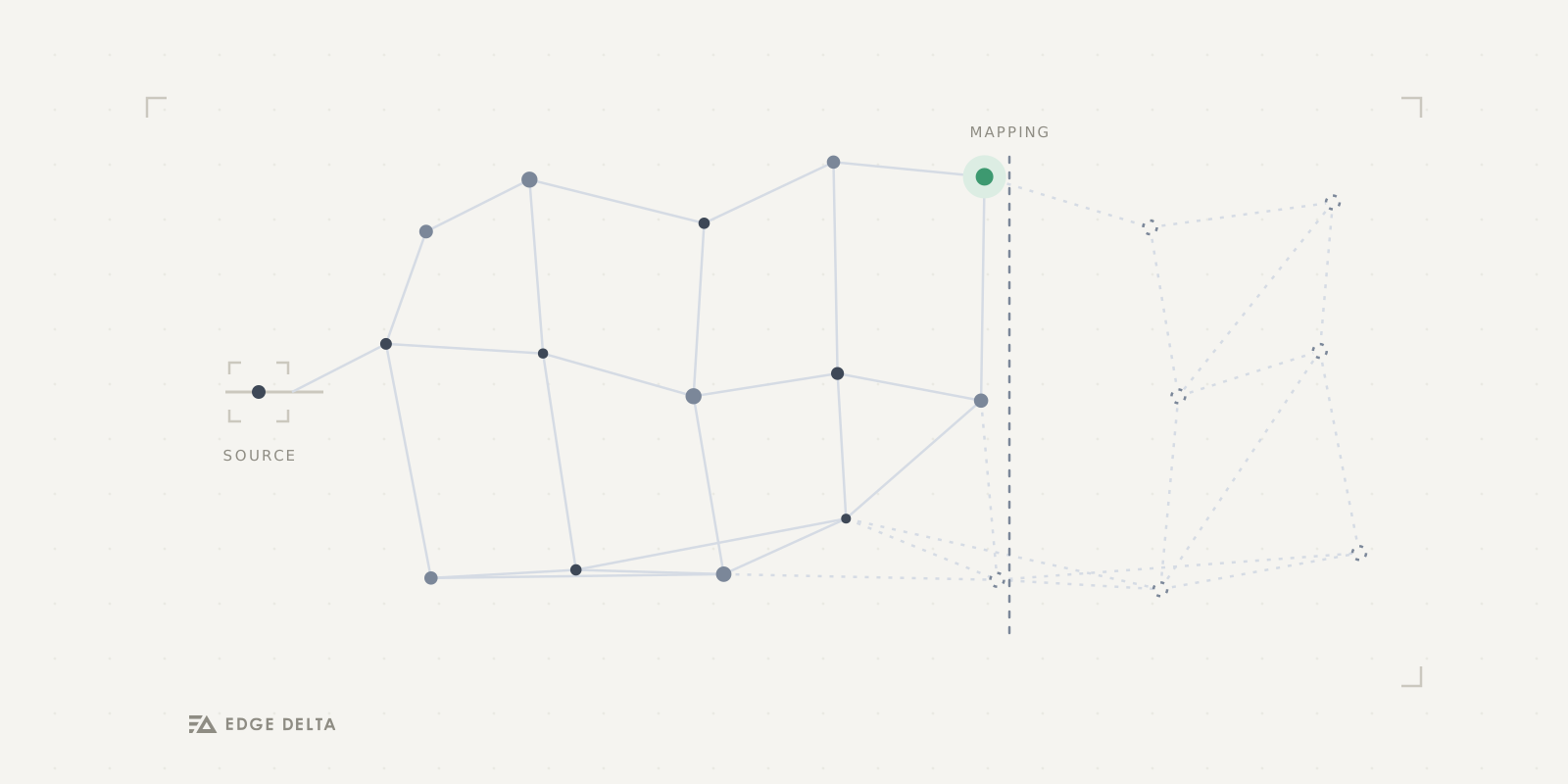
From the minute you connect a source, OnCall AI begins mapping your environment: services, repositories, channels, ticket projects, cloud resources, and the relationships between them. What depends on what. What runs where. Who owns what, where each service is discussed, where its incidents are tracked, and even the runbooks that describe how to operate it.
It works with the tools you already connect - source control, chat, on-call, ticketing, cloud - and every new connection makes the map richer. Your Kubernetes environments come in automatically, drawn from Edge Delta’s eBPF-based service map. There is no configuration step, no file to upload, and nothing to teach it. By the time you open your first incident thread, your AI teammate already knows your topology.
Watch it learn
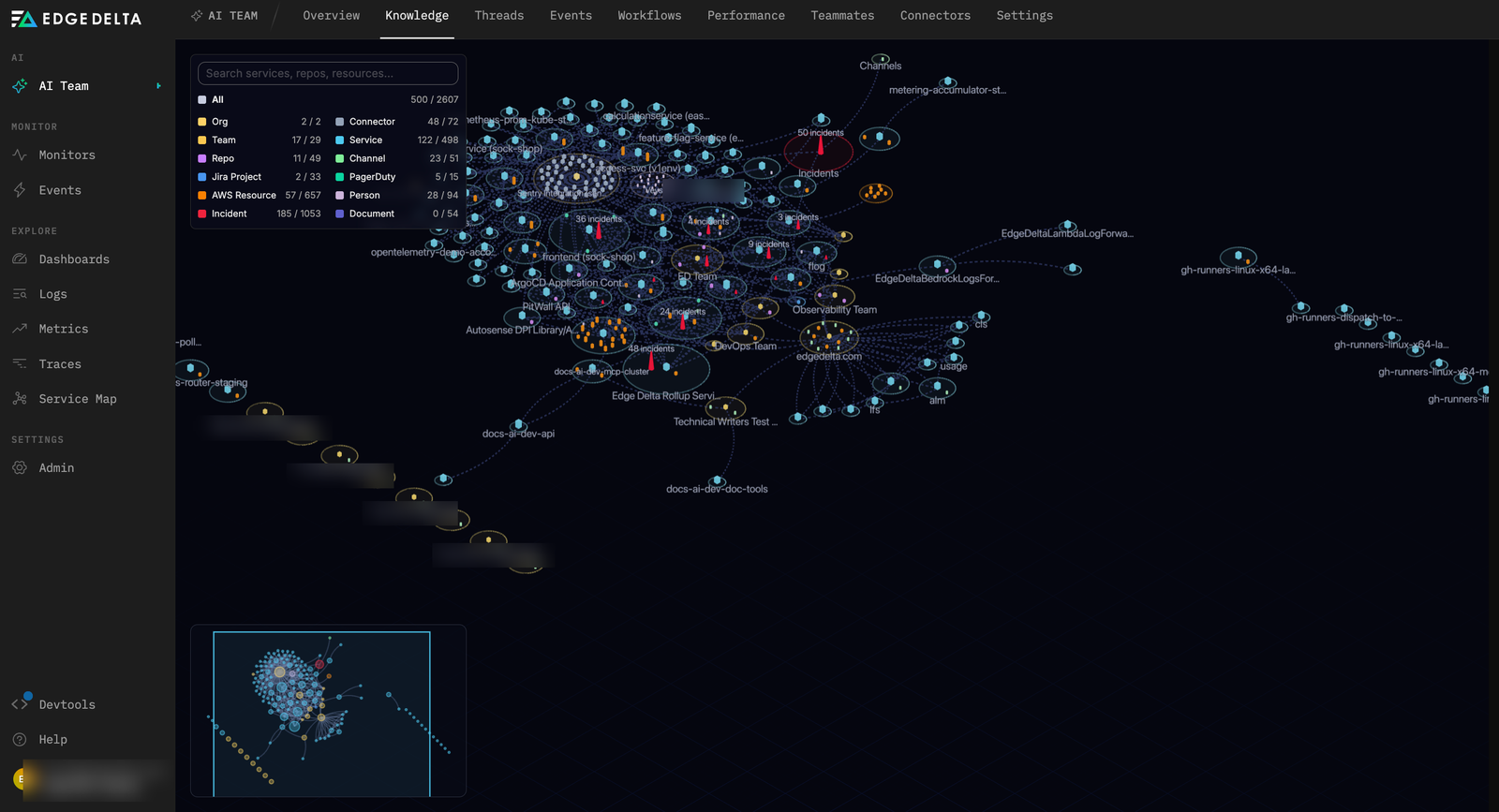
Nobody drew this map. Every node was discovered from the tools this team already uses.
Open the Knowledge page and you can literally watch it happen. Your organization appears first, then your integrations, your teams, your services, and outward from there, until your whole environment hangs in front of you as a living, 3D “city of districts.” Every relationship on screen was discovered, not documented. Each fact carries the source it came from, and the map refreshes as your system changes, so it stays current without anyone maintaining it.
It’s a genuinely fun thing to explore. But the map isn’t the product. The map is what makes the next part possible.
When the incident comes, the map is already there
Because the learning happened early, the answering is instant.
Blast radius. Pick any service and see its failure surface immediately: everything it depends on, directly and transitively, with the closest dependencies weighted heaviest. When checkout degrades, “what does this touch?” stops being a question you answer by scrolling old Slack threads. It’s one look at a map that already exists.
Criticality. OnCall AI also already knows which parts of your system the most things depend on, which is what severity judgments actually hinge on. And it knows the difference between popular and critical: in one early environment, the most connected node in the entire graph turned out to have a criticality of zero, because plenty of things touched it and nothing truly depended on it. That distinction is easy for a human expert, invisible to a keyword search, and native to a graph.
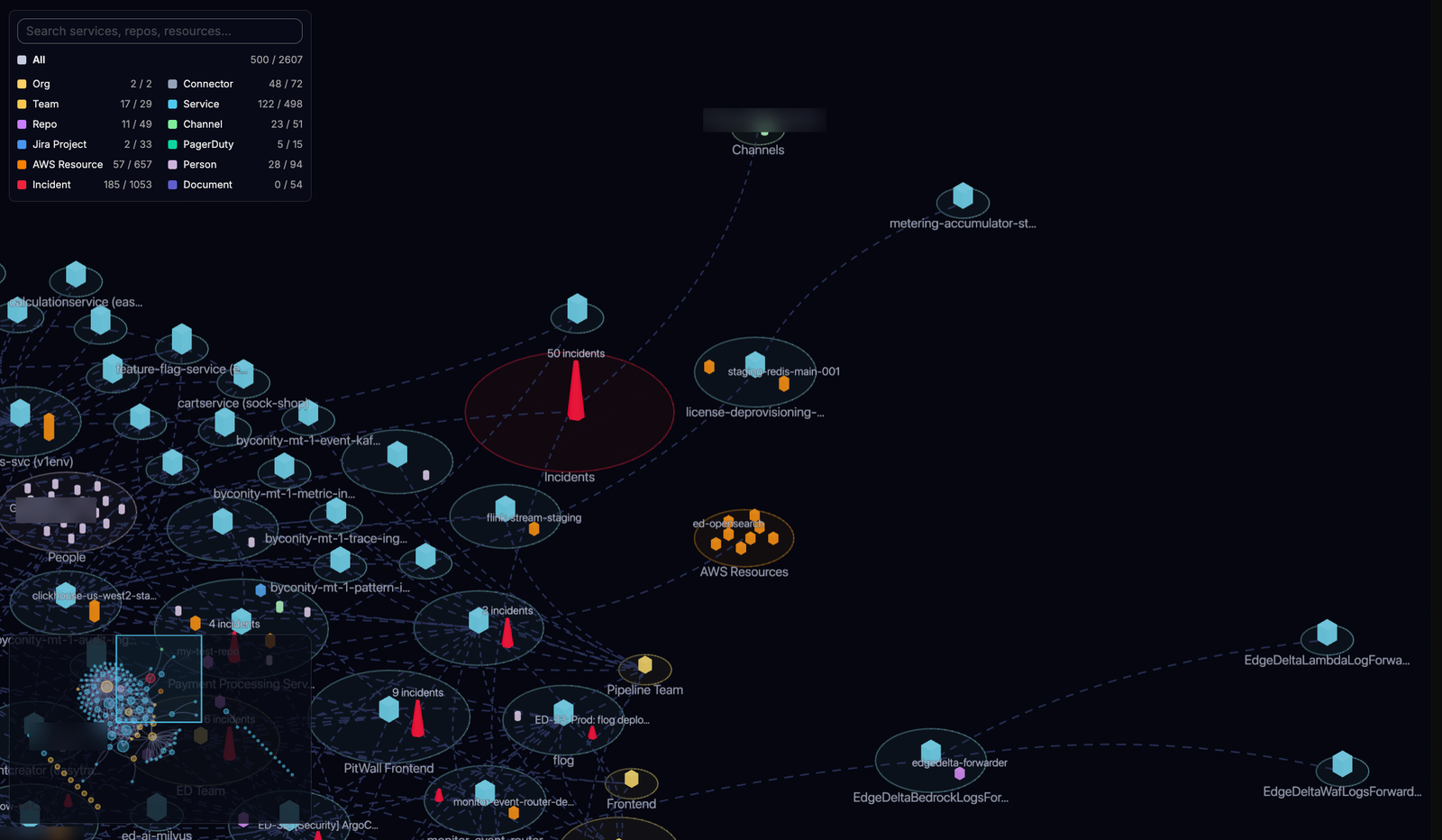
The map, sized by criticality: the parts of your system the most things depend on stand out, and a cluster under fire glows red.
Connected is not the same as critical. Your AI teammate now knows the difference.
Proactive doesn’t stop at answers
The knowledge graph is the first rung of a ladder, and each rung is more proactive than the last.
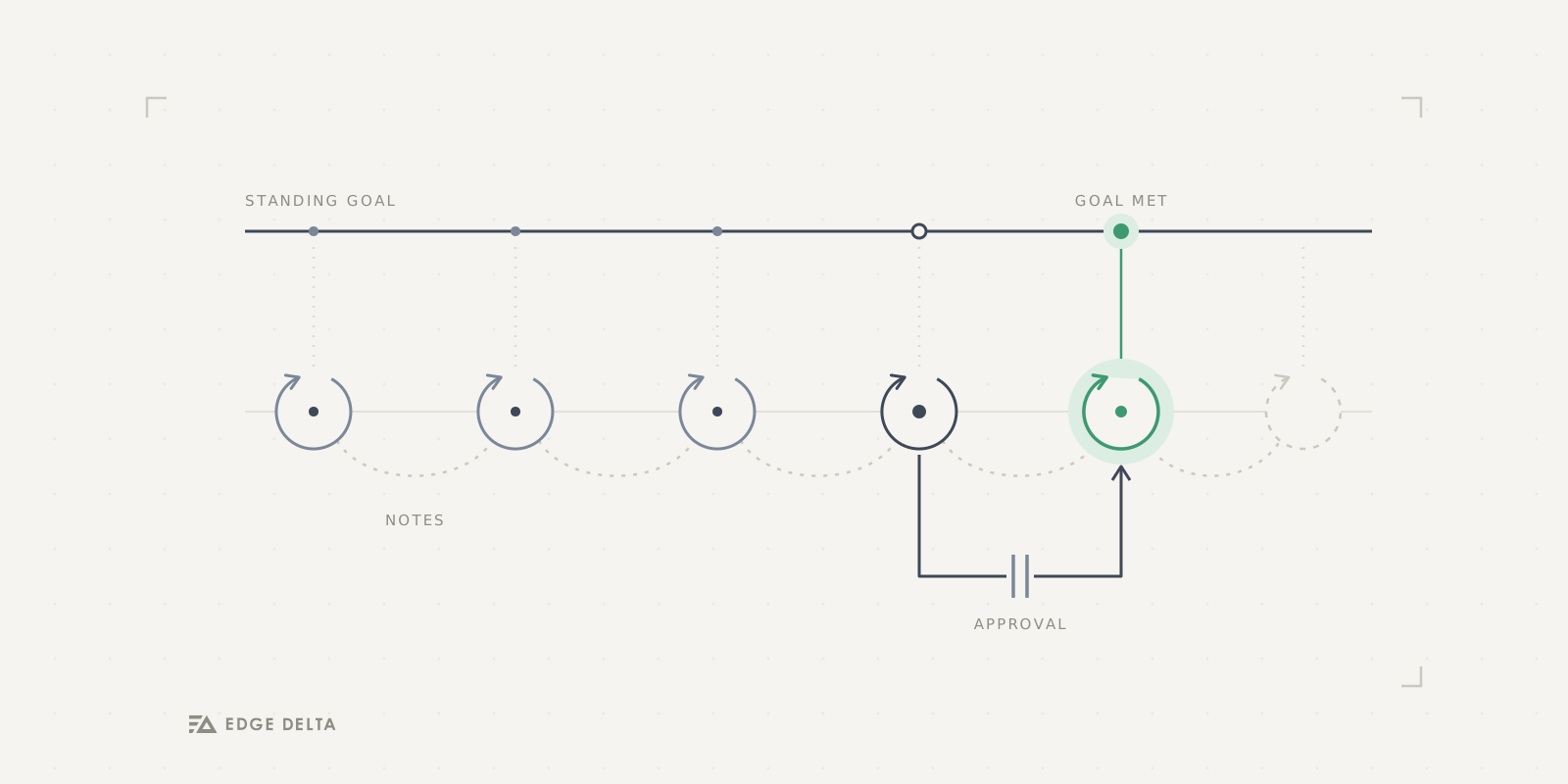
It keeps learning. Learning starts before your first question, and it doesn’t stop after. The next phase of this work makes every investigation a lesson: as OnCall AI works incidents with your team, the relationships that only reveal themselves under fire, the ones no integration can see from the outside, get captured and added to the map. The longer it works with you, the better it knows your system, the same way your best engineers got that way.
And soon, it starts asking the questions. Here’s a glimpse of where this goes: an agent that studies your map the way a thorough SRE studies a new environment, and comes to you with what it finds. “Checkout has twelve downstream dependencies, and two of them have no scheduled check covering them. Want me to run one every fifteen minutes?” Recommended periodic checks, derived from your actual topology rather than a generic checklist, reviewed and approved by you. The map doesn’t just answer during incidents. It tells you where the next one is hiding.
A reactive agent answers your questions. A proactive one learns your system before you ask, and then starts asking the right questions for you.
See your system appear
Already on Edge Delta? Connect your sources and open the Knowledge page. Within minutes you’ll be looking at a map of your own environment that nobody had to draw.
New to Edge Delta? Sign up and see what a proactive AI teammate, one that already knows your system on day one, actually feels like.
Questions you might have
Is my environment data isolated?
Yes. Each organization’s graph is fully isolated from every other organization’s, and it is removed entirely if you leave.
Which sources does it learn from?
Any source you connect: source control like GitHub or GitLab, chat like Slack, on-call like PagerDuty, ticketing like Jira, and cloud like AWS. Your Kubernetes environments are mapped automatically through Edge Delta’s eBPF-based service map. The more you connect, the richer the map.
What if the map is wrong or out of date?
Every fact carries where it came from and how confident we are in it. Re-discovery reinforces what’s still true, and facts that are no longer observed are removed on the next reconciliation, so the map converges on reality rather than accumulating stale claims.