
PII masking in log streams is a foundational requirement for protecting customer data, meeting compliance obligations, and reducing risk as data volumes grow. The process sounds straightforward, until throughput drops, buffers back up, and ingestion becomes unstable under real production load. Teams are often forced to trade performance for security, accepting slower ingestion, increased resource usage, or reduced reliability in order to ensure sensitive data is protected.
In this post, we compare Edge Delta and Bindplane’s ability to mask PII data at scale while ingesting logs via HTTP. Both solutions were tested under identical conditions to evaluate throughput, stability, and resource behavior.
What We’re Masking
The following types of sensitive data appear frequently in log streams:
- Email addresses
- Credit card numbers (Visa, Mastercard, Amex, Discover)
- IP addresses (IPv4 and IPv6)
- MAC addresses
- International Bank Account Numbers (IBAN)
Both Edge Delta and Bindplane mask these patterns in real-time using regex-based processors.
Test Setup
Test Fairness and Assumptions
To keep the comparison fair and repeatable, both platforms were evaluated under the same test conditions:
- Same host machine and hardware (12-core Apple Silicon Mac)
- Same PII patterns and masking logic
- No downstream exporters enabled
- Warm-up period excluded from measurements
- No artificial rate limits applied
Versions
- Edge Delta v2.12.0-rc.35
- BindPlane v1.91.0
Load Generator
We used httploggen, an open-source tool that generates realistic nginx logs with embedded PII data.
Test Configuration
To generate sustained, high-throughput load, we ran 80 concurrent workers, each sending one log event per millisecond for one minute:
bash
./httploggen \
    --endpoint http://localhost:808X \
    --format nginx_log \
    --number 1 \
    --workers 80 \
    --period 1ms \
    --total-time 1m
Configuration Overview
Both configurations implement similar PII masking patterns:
Edge Delta Configuration
yaml
version: v3

# HTTP Input
- name: http_input
  type: http_input
  port: 8085
  log_parsing_mode: json

# PII Masking Processor
- name: multiprocessor
  type: sequence
  processors:
  - type: generic_mask
    capture_group_masks:
    - name: IPv4 Address
      mask: REDACTED
    - name: Email Address
      mask: REDACTED
    - name: Credit Card (Visa/MC/Amex/Discover)
      mask: REDACTED
    - name: IBAN
      mask: REDACTED
    - name: IPv6 Address
      mask: REDACTED
    - name: MAC Address
      mask: REDACTED
Bindplane Configuration
yaml
# HTTP Receiver
receivers:
  http/source:
    endpoint: 0.0.0.0:8086

# Redaction Processor
processors:
  redaction/processor:
    allow_all_keys: true
    blocked_values:
      - '\b[A-Z]{2}\d{2}(?: ?[A-Z0-9]){11,31}...'  # IBAN
      - \b([0-9A-Fa-f]{2}[:-]){5}[0-9A-Fa-f]{2}\b  # MAC
      - \b(?:3[47][ -]?\d{4}[ -]?\d{6}...)         # Cards
      - \b[a-zA-Z0-9._/\+\-—|]+@[A-Za-z...]        # Email
      - \b(?:(?:25[0-5]|2[0-4][0-9]...)...)        # IPv4
      - \b(?:[0-9a-fA-F]{1,4}:){7}...              # IPv6
    redact_all_types: true
Performance Results
Throughput Comparison
Performance Comparison: Edge Delta vs Bindplane
| Metric | Edge Delta | Bindplane | Advantage |
|---|---|---|---|
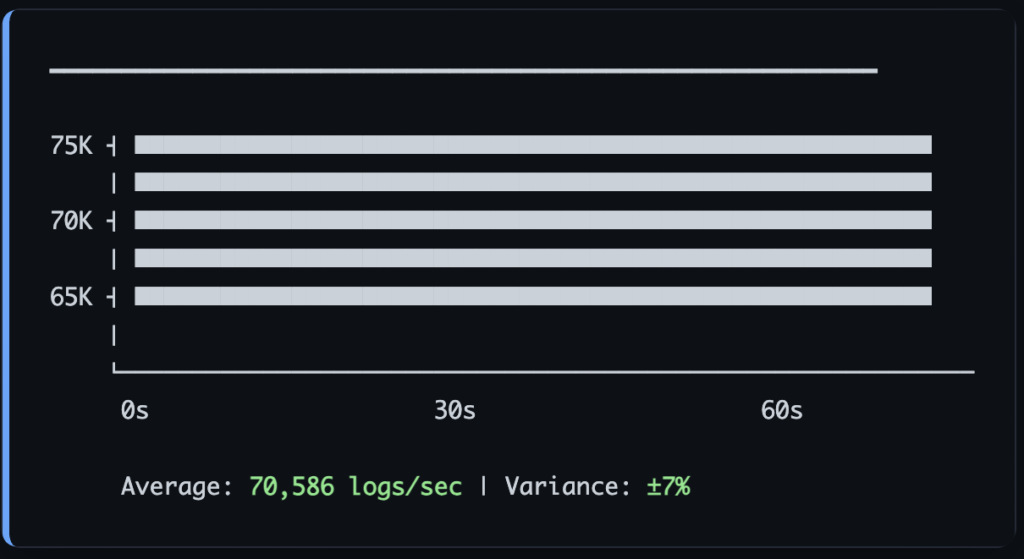
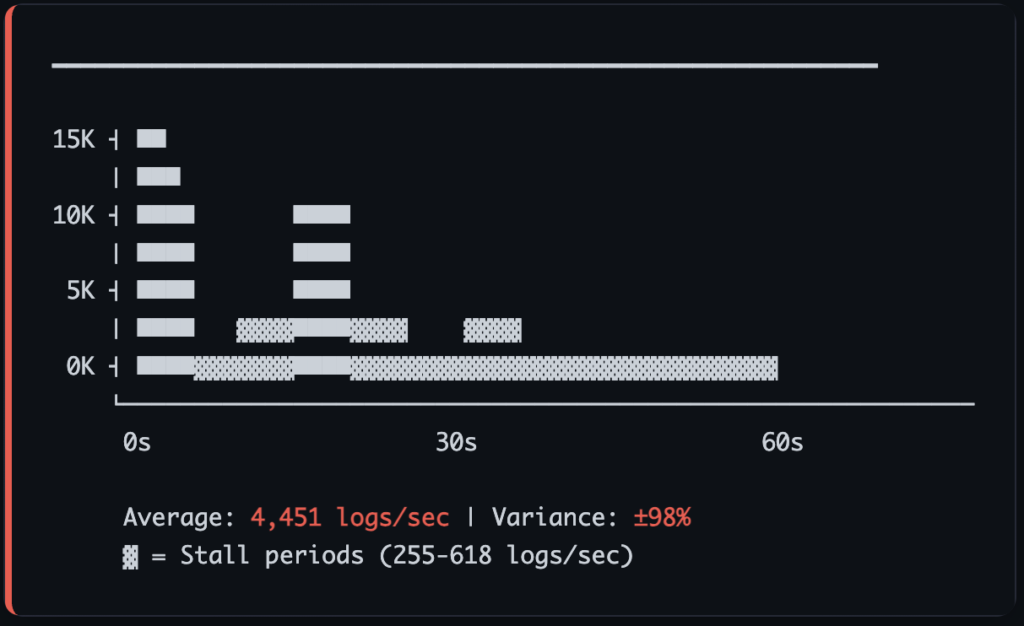
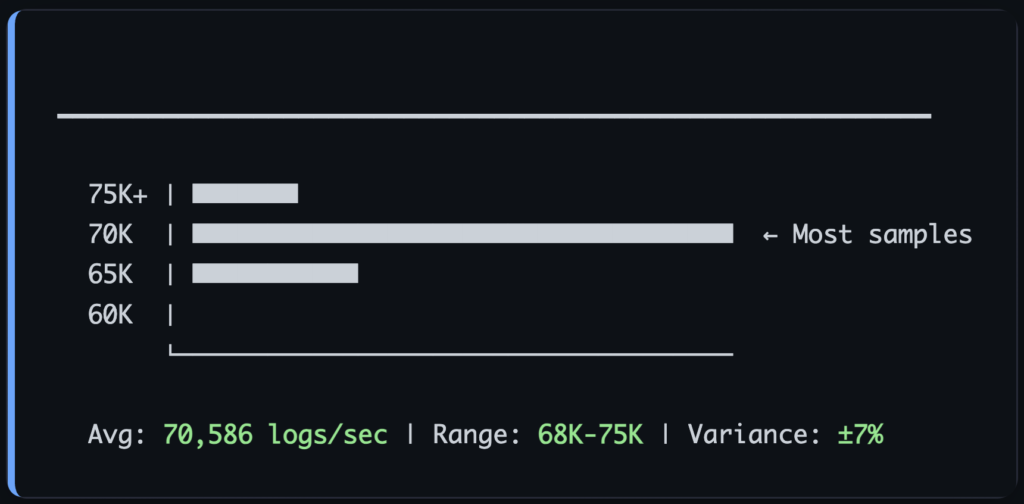
| Average Events Throughput | 70,586 logs/sec4.24M logs/min6.1B logs/day | 4,451 logs/sec267K logs/min384.6M logs/day | 15.9x faster |
| Average Volume Throughput | 50 mb/sec3 GB/min4.32 TB/day | 3.15 mb/sec189 MB/min272.16 GB/day | 15.9x faster |
| Throughput Variance | ±7% | ±98% | 59x more stable |
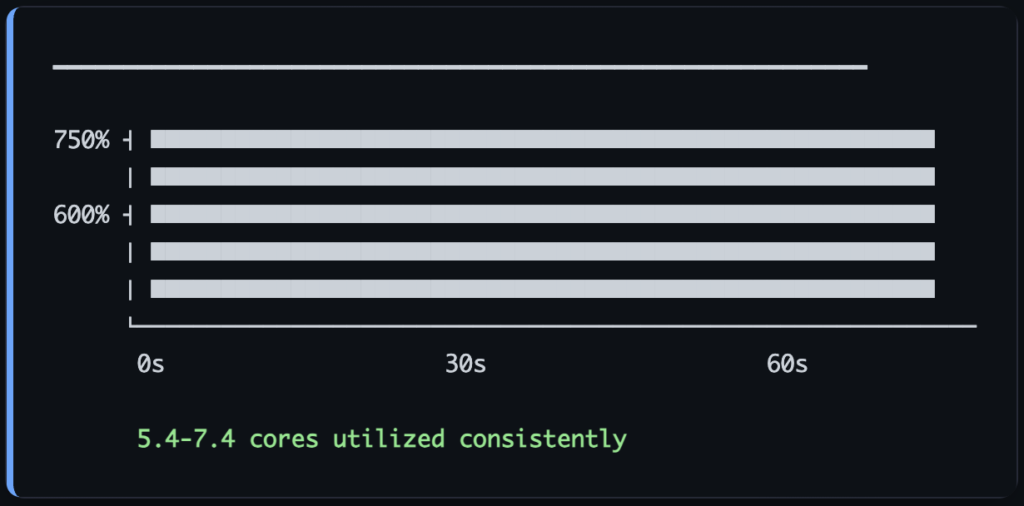
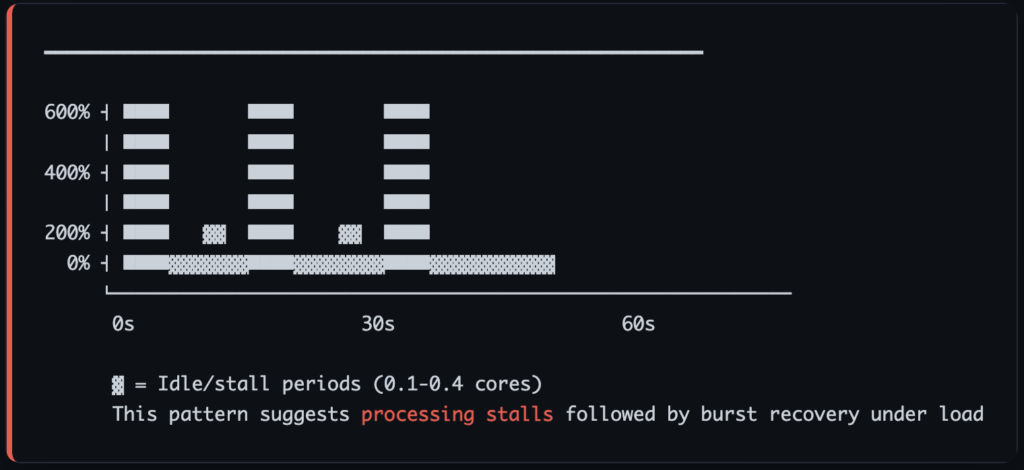
| CPU Usage | 5.4-7.4 cores | 0.1-5.6 cores | Consistent |
Throughput Over Time
Edge Delta: Sustained High Performance
Bindplane: Highly Variable Throughput
CPU Utilization Pattern
Edge Delta: Consistent Processing
Bindplane: Periodic Stall and Burst Pattern
Performance Breakdown
Throughput Distribution
Edge Delta Throughput Distribution (1 minute test)
Bindplane Throughput Distribution (1 minute test)
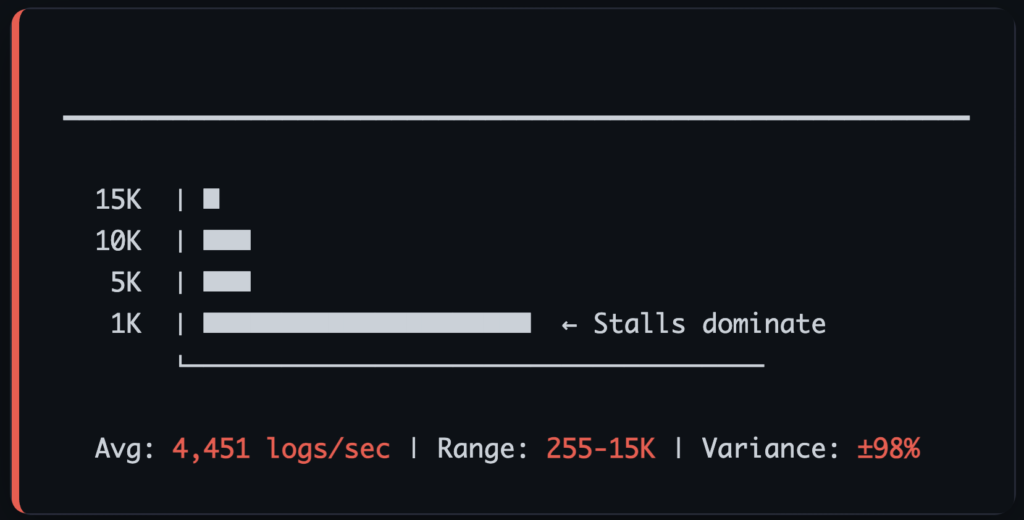
Key Metrics Summary
Performance Comparison: Edge Delta vs Bindplane
| Metric | Edge Delta | Bindplane | Advantage |
|---|---|---|---|
| Average Events Throughput | 70,586 logs/sec4.24M logs/min6.1B logs/day | 4,451 logs/sec267K logs/min384.6M logs/day | 15.9x faster |
| Average Volume Throughput | 50 mb/sec3 GB/min4.32 TB/day | 3.15 mb/sec189 MB/min272.16 GB/day | 15.9x faster |
| Min Events Throughput | 68,000 logs/sec4.08M logs/min5.87B logs/day | 255 logs/sec15.3K logs/min22M logs/day | 266.7x faster |
| Min Volume Throughput | 48.17 mb/sec2.89 GB/min4.16 TB/day | 0.18 mb/sec10.8 MB/min15.55 GB/day | 266.7x faster |
| Max Events Throughput | 75,000 logs/sec4.5M logs/min6.48B logs/day | 15,332 logs/sec920K logs/min1.32B logs/day | 4.9x faster |
| Max Volume Throughput | 53.13 mb/sec3.19 GB/min4.59 TB/day | 10.86 mb/sec652 MB/min938.3 GB/day | 4.9x faster |
| Throughput Variance | ±7% | ±98% | 59x more stable |
| CPU Usage | 5.4-7.4 cores | 0.1-5.6 cores | Consistent |
Key Takeaways
Edge Delta demonstrated clear advantages over Bindplane across the following dimensions.
- Performance: Edge Delta delivers 15.9x higher throughput while masking the same PII patterns.
- Stability: Edge Delta maintains ±7% variance vs Bindplane’s ±98% variance, critical for production reliability.
- Efficiency: Consistent CPU utilization (5.4-7.4 cores) without freeze/burst patterns means predictable resource usage.
- Cost Impact: Higher throughput and efficiency translate directly to lower infrastructure costs.
Try It Yourself
To reproduce these results, follow these steps:
Step 1: Clone the load generator:
bash
git clone https://github.com/edgedelta/httploggen
cd httploggen
go build
Step 2: Run the test:
bash
./httploggen \
  --endpoint http://localhost:8085 \
    --format nginx_log \
    --number 1 \
    --workers 80 \
    --period 1ms \
    --total-time 1m
Step 3: Monitor your collector and compare the results.
Conclusion
When applying PII masking at high ingest rates, performance and stability become critical. In this test, Edge Delta sustained significantly higher throughput with far lower variance:
- 15.9x higher throughput (70,586 vs 4,451 logs/sec)
- 59x better stability (±7% vs ±98% variance)
- Consistent CPU efficiency with no stalls
- Zero errors and zero backpressure under sustained load
If you have questions about PII masking, performance optimization, or telemetry pipelines, book a meeting with a member of our technical team. We’re here to help.