
Shared codebases can create friction that compounds as teams grow. Every day, engineers across time zones push commits, open pull requests, and merge changes, often without full visibility into what else is in flight. Reviewers are stretched thin, context is lost between handoffs, and the sheer volume of PRs can cause subtle issues like a silent regression, a misconfigured dependency, or a security edge case to slip through. The cost is hours spent in review cycles, CI/CD failures at the worst moments, and customer-facing bugs that erode trust.
Edge Delta’s AI Teammates change that narrative by integrating directly with GitHub to automate code reviews and catch problems before they reach production. This enables teams to ship features faster and with more confidence, without getting caught in endless back-and-forth.
In this post, we’ll first walk through how to connect GitHub to Edge Delta so that AI Teammates can access your repos, pull requests, workflows, and security alerts. Then, we’ll explore three common GitHub scenarios where AI Teammates reduce engineering overhead through automated, continuous development support.
Set Up the Edge Delta GitHub Connector
Edge Delta Connectors bridge AI Teammates and your infrastructure, development tools, cloud platforms, and data sources. The GitHub Connector gives these out-of-the-box agents direct access to your development workflow and artifacts, including repos, pull requests, issues, GitHub Actions runs, and security scanning results. This enables your AI Teammates to see code level changes, CI failures, and flagged vulnerabilities, and correlate them with real-time telemetry data and events from across your stack.
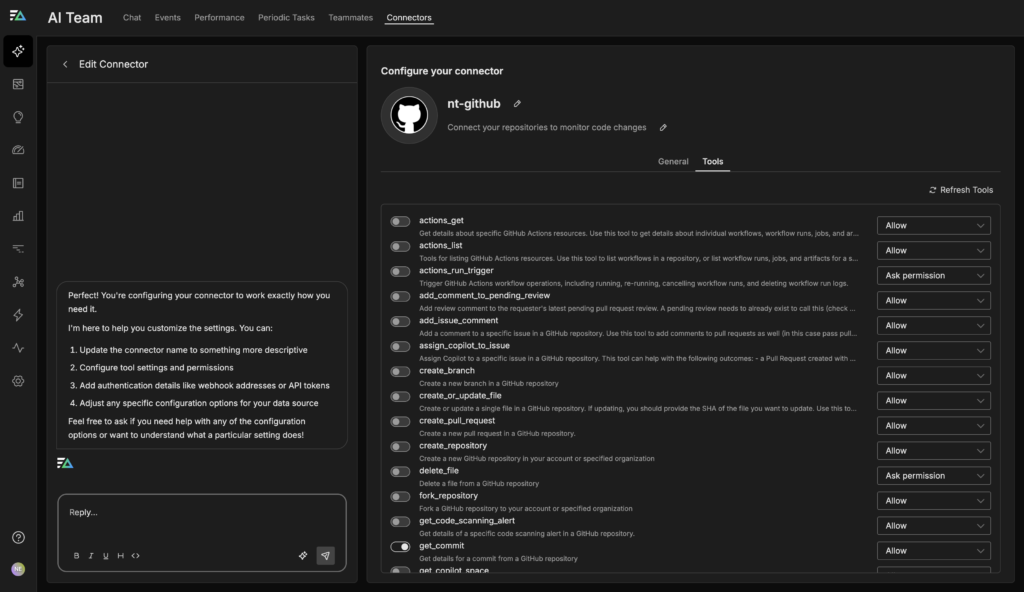
Once connected, Edge Delta automatically receives events from all of the repositories the authenticated account can access, routing them through the AI Event destination to trigger AI Teammate responses. This means that AI Teammates are ready to review pull requests for quality and security problems, manage and triage GitHub issues, and debug failing CI/CD workflows, all while keeping the human in the loop.
For more information on setting up the GitHub Connector, check out Edge Delta’s documentation.
Automate PR Reviews
PR reviews are a bottleneck in most engineering teams. Reviewers get swamped, PRs sit idle waiting for a first pass, and quality issues slip through when engineers are stretched thin. AI Teammates address these challenges by automatically reviewing every pull request the moment it’s opened, examining the diff and posting initial feedback before a human reviewer ever opens a tab. This accelerates review cycles by reducing back-and-forth while supporting a higher quality baseline across every PR.
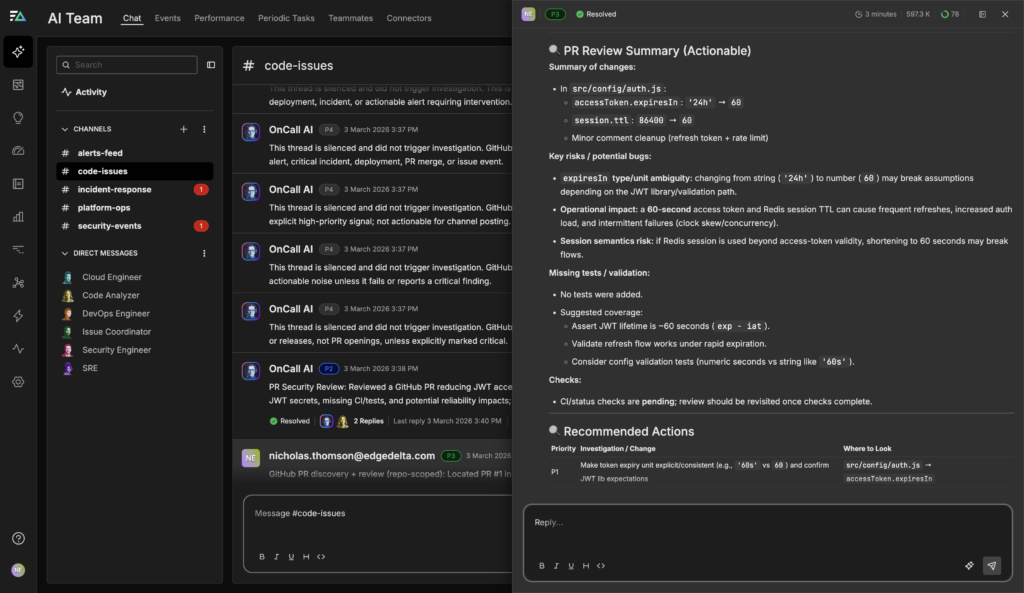
In the example below, a developer tagged @edge-delta in a PR comment requesting a security and reliability review. OnCall AI then located the PR, pulled the diff and changed files, and identified two high-priority risks in src/config/auth.js: an expiresIn value that changed from a string ('24h') to a bare integer (60), creating JWT library ambiguity, and a Redis session TTL reduced to 60 seconds, short enough to cause frequent auth failures from clock skew or concurrency issues. OnCall AI flagged both as P1 items, suggested specific test coverage, and noted that CI checks were still pending before merge:
Coordinate Releases Across Multiple PRs
As a release window approaches, engineering leads face the same time-consuming ritual: manually checking which PRs are approved, which are blocked on failing checks, and which are still waiting on reviewers. This process involves pivoting back and forth between GitHub and Slack, making it easy for mistakes to slip through or for a broken build to stall the entire release.
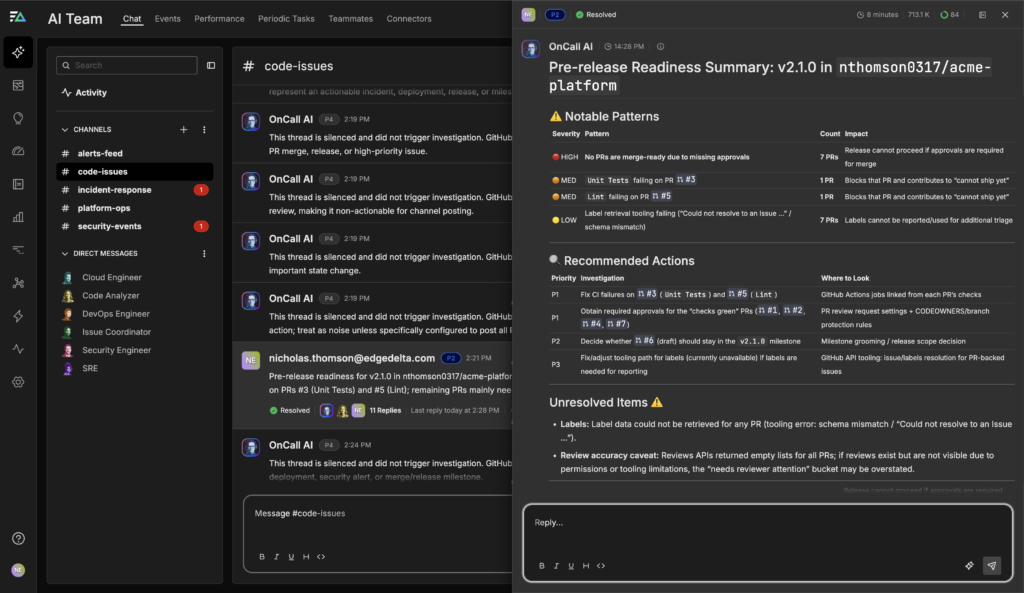
AI Teammates handle this coordination work automatically, delivering a complete, prioritized readiness snapshot that lets the human team know exactly what needs to happen before anything ships. In the example below, OnCall AI was asked for a pre-release readiness summary for nthomson0317/acme-platform scoped to the v2.1.0 milestone. It then queried all seven open PRs, pulled CI check results and merge states for each, and returned a structured readiness breakdown in seconds. The verdict: no PRs were merge-ready. Four had green checks but were missing approvals, two were blocked on CI failures, and one was still in draft. OnCall AI surfaced P1 actions for each blocker and flagged the draft PR as a milestone scoping decision for the team to resolve:
Debug Failing GitHub Actions Workflows
CI/CD tools like GitHub Actions play a crucial role in the software development lifecycle, automating the build, test, and deployment processes that help teams ship changes reliably. But when a workflow fails, diagnosing the issue often involves digging through hundreds of lines of logs across multiple jobs just to find a single root cause buried at the bottom of a failed step. This frustrating process delays deployments and gradually erodes developer confidence in the pipeline.
AI Teammates address this problem by stepping in the moment a GitHub Actions workflow fails, keeping developers from getting stuck in log archaeology and leading to faster time-to-green. In the example below, OnCall AI located the most recent failing run in the acme-platform nightly build, identified three failed jobs, and pinpointed the exact failing step in each. Within the same analysis, it flagged a secondary issue: no scheduled runs were found despite the workflow being named “Nightly Build,” suggesting the cron schedule may be misconfigured or disabled entirely:
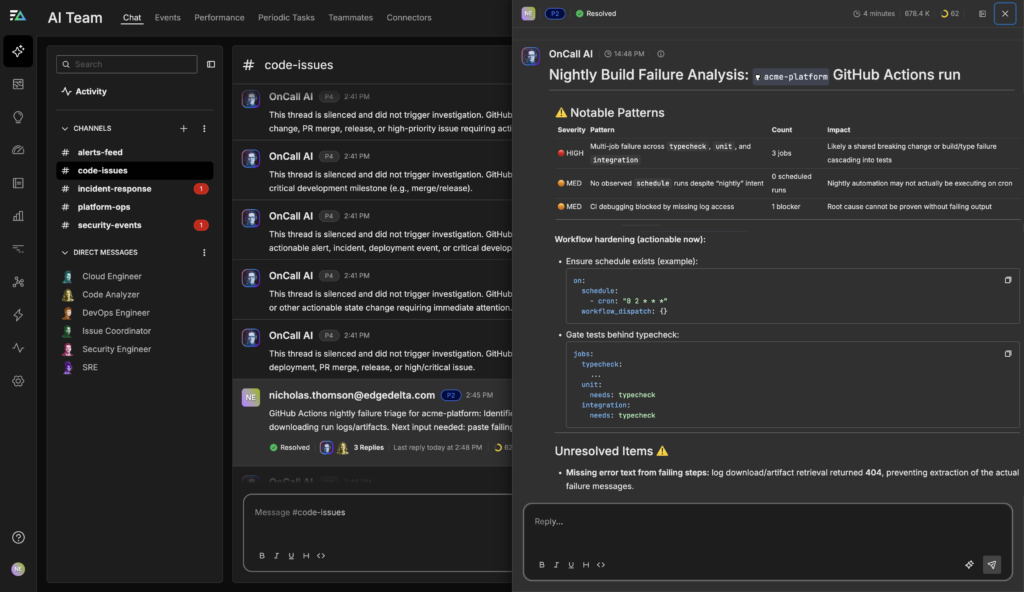
The Teammate’s leading hypothesis was a TypeScript type-check failure cascading into the unit and integration jobs downstream, and it immediately surfaced two workflow hardening recommendations: confirming the on: schedule trigger existed in .github/workflows/nightly.yml, and gating unit and integration jobs behind a successful typecheck with needs: typecheck to reduce noise and cost. Log retrieval hit a tooling limitation in this run, so it flagged the specific failing steps and requested the raw output to confirm root cause before issuing a final fix recommendation.
Get Started
Edge Delta’s AI Teammates connect directly to cloud platforms, data sources, and development tools, proactively analyzing signals and events from production data to deliver measurable impact from day one. By connecting AI Teammates to GitHub, human teams are able to automate PR reviews, release readiness checks, and workflow failure investigations, freeing them to focus on architecture decisions, feature work, and problems that actually require engineering judgment. It’s what the software development lifecycle looks like in the age of agentic AI.
Try AI Teammates yourself with a free trial.