

In CI/CD environments, merge hell rarely appears as a single catastrophic event. Instead, it emerges as a lingering state. Integration slows. Merges that seemed routine in isolation suddenly fail. Pull requests grow larger as teams hesitate to merge, waiting for a safer window that never quite arrives. Eventually, pipelines become the point where weeks of quiet divergence collide all at once.
This is not a Git proficiency issue. Merge hell reflects a breakdown in version control hygiene that CI/CD pipelines expose rather than create. When hygiene slips, pipelines magnify the cost of integration by forcing divergent changes to interact under real conditions instead of theoretical ones.
This post focuses on prevention, not cleanup. There are no conflict resolution tricks here and no Git command walkthroughs. Instead, we examine what version control hygiene actually means in CI/CD systems, why merge hell becomes more likely as teams and codebases scale, and which system level practices keep integration routine instead of risky.
Key Takeaways
∙ Merge hell is a persistent state, not a single bad merge. It shows up when integration keeps failing because divergence has accumulated over time.
∙ CI/CD pipelines reveal problems rather than cause them. Pipelines surface the real cost of delayed integration by testing the system as a whole.
∙ Short-lived branches dramatically reduce merge risk. The less time a branch exists, the less its assumptions drift from the mainline.
∙ Smaller changes make integration safer and easier to debug. Incremental updates fail faster and limit how many things can go wrong at once.
∙ Version control hygiene requires enforcement, not trust. CI must block stale or broken merges to keep integration predictable under pressure.
∙ Delayed integration becomes exponentially harder as teams grow. As parallel work increases, the cost of merging rises rapidly, often without warning.
What Is Merge Hell in CI/CD?
Merge hell is not defined by the presence of conflicts. It is defined by repetition.
In CI/CD systems, merge hell appears when integration repeatedly breaks the build and slows delivery, even when individual changes seem reasonable on their own. Branches drift for extended periods. Integration is deferred.
When those changes finally meet, the pipeline becomes the first place where their incompatibilities are exercised. What feels sudden is usually the result of slow accumulation.
How Merge Hell Differs from Normal Merge Conflicts
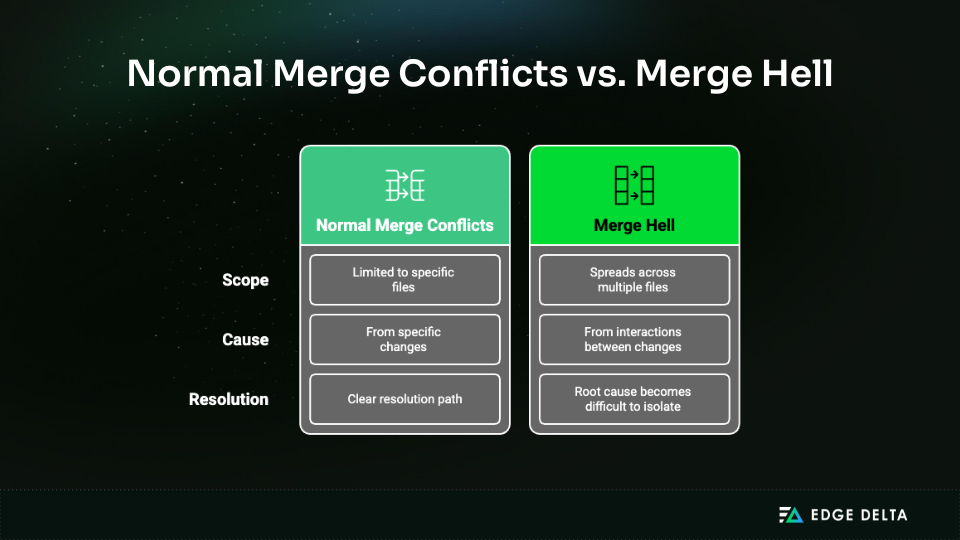
Ordinary merge conflicts are limited in scope. They involve specific files, specific changes, and a clear resolution path. Merge hell behaves differently:
- Conflicts spread across multiple files or subsystems
- Failures emerge from interactions rather than single changes
- Root causes become difficult to isolate because many changes land together
Conflicts are discrete events. Merge hell is a condition that persists until integration habits change.
Why Merge Hell Becomes More Visible in CI/CD Pipelines
CI/CD pipelines take away the comfort of abstraction by using production telemetry to test the system instead of developer guesses. They test the system as it is after integration, not how each branch thinks it should be.
This collapses the gap between expectation and reality. Pipelines do not introduce merge hell. They surface the cost of letting divergence grow unchecked.
How Do You Maintain Version Control Hygiene in CI/CD?
Version control hygiene is about making integration predictable. In CI/CD environments, predictability does not come from intent alone. It comes from enforcement.
The practices below focus on preventing divergence early, before it compounds into something expensive.
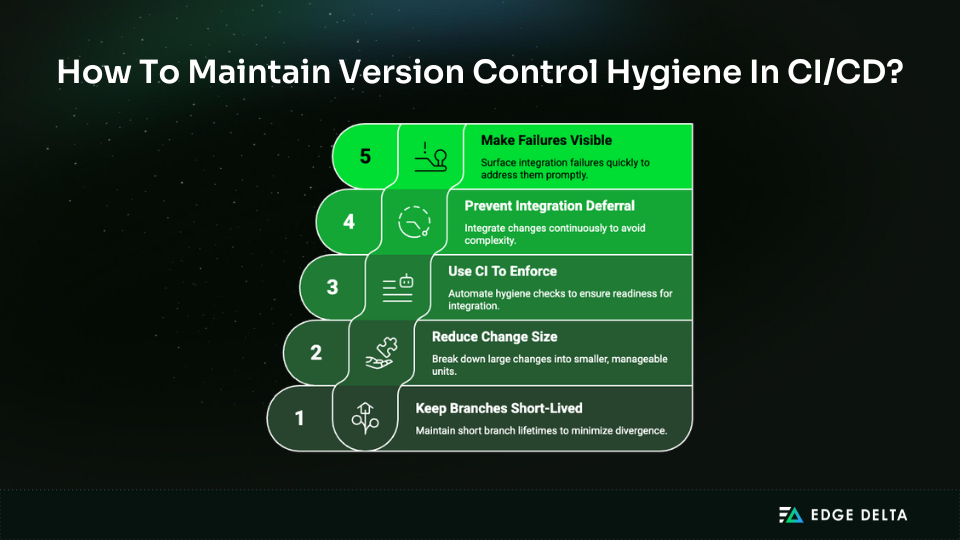
Step 1: Keep Branches Short-Lived
One of the strongest indicators that merging will be difficult later is how long a branch remains open. The longer a branch lives, the more the mainline evolves independently. This increases the chance that small assumptions change in subtle ways.
Healthy version control hygiene favors:
- Branch lifetimes measured in days rather than weeks
- Frequent integration into the main branch
- Continuous validation through CI
Short-lived branches preserve context and limit how far divergence can spread before integration forces reconciliation.
Step 2: Reduce Change Size Before Integration
Large changes tend to bundle multiple concerns together. When those bundles collide, failures become harder to diagnose and fix.
CI/CD systems handle incremental change far better than sweeping updates. Smaller changes fail faster, provide clearer signals, and reduce the likelihood that unrelated work interferes with itself. This does not require features to be finished before merging. It requires structuring work, so partial integration is safe.
Step 3: Use CI to Enforce Hygiene Automatically
CI should verify that a change is ready to integrate. It should confirm not only that code compiles or passes tests in isolation, but that it preserves signal quality across interacting components. Pipelines that accept stale branches create confidence that does not hold up during real integration.
At a minimum, enforcement means:
- Branches must be up to date with the mainline
- Integration checks run against the combined state
- Broken builds block further merges
Automation matters because hygiene is most likely to erode under delivery pressure.
Step 4: Prevent Integration Deferral
Merge hell often begins with delay. Teams wait to integrate until a feature feels complete or a quieter moment appears. Meanwhile, the system keeps moving.
Integration deferral is costly because merge complexity grows faster than the changes themselves. Each additional change on the main branch increases the number of interactions that must eventually be reconciled.
Treating integration as a continuous activity is what keeps this cost bounded.
Step 5: Make Integration Failures Visible and Actionable
When integration failures linger, teams adapt in unhealthy ways. Broken builds become background noise when failures are detected but not triaged or acted on quickly. Work continues around the pipeline instead of through it.
CI/CD solutions need to promptly show integration problems and make them hard to ignore. Quick, unavoidable feedback keeps divergence small enough to fix before it spreads.
How Hygiene Practices Reduce Merge Hell Risk
| Hygiene Practice | What It Controls | Impact on CI/CD |
|---|---|---|
| Short-lived branches | Branch divergence | Lower merge complexity |
| Small change sets | Conflict surface area | Faster diagnosis |
| CI enforcement | Integration readiness | Fewer broken merges |
| Continuous integration | Deferred risk | Predictable pipelines |
Why Does Merge Hell Emerge as Teams Scale?
As teams grow, parallel work increases and more branches exist at the same time. Assumptions begin to evolve independently, which makes the system progressively harder to keep aligned.
Why Branch Divergence Grows with Team Size
With more people working in parallel, changes are more likely to depend on overlapping concepts even when code does not overlap directly. This is a pattern amplified by widespread cloud adoption and distributed architectures across modern teams.
In isolated branches, these m/ismatches are not always clear. If you don’t integrate often, conflicting assumptions build up quietly until the pipeline makes them interact.
Why Delayed Integration Increases Merge Cost Disproportionately
The merge cost does not rise in a straight line. Each delay increases the number of interacting changes and the effort required to understand failures. Teams often reach a tipping point where merging shifts from routine to chaotic with little warning.
Where Does Version Control Hygiene Break Down in CI/CD?
Version control hygiene does not usually fail uniformly across a delivery system. It weakens at specific points where coordination becomes harder and feedback arrives later than it should. In CI/CD environments, these weak spots allow divergence to grow quietly until integration forces it into the open.
Understanding where hygiene tends to erode helps explain why merge hell often appears suddenly, even though its causes have been accumulating for some time.
Where Hygiene Breaks Down in Pull Request Workflows
Pull requests become liabilities when they grow large or linger. Reviews slow down and integration is postponed, allowing divergence to accelerate behind the scenes. When PRs represent completed features rather than integration units, version control hygiene begins to weaken.
Where Hygiene Erodes at the CI Boundary
Some pipelines validate branches in isolation instead of enforcing integration against the latest mainline. This produces confidence that disappears once changes are combined. Hygiene breaks when CI checks success in isolation rather than success in combination.
Why Poor Version Control Hygiene Damages CI/CD Reliability
Poor version control hygiene has consequences that extend beyond individual merges or developer workflows. In CI/CD systems, it alters how reliably the pipeline reflects the true state of the system under change.
As divergence grows, failures become more difficult to understand, and recovery takes longer. Over time, these effects add up, making pipelines less reliable even when no single modification seems to be a problem on its own.
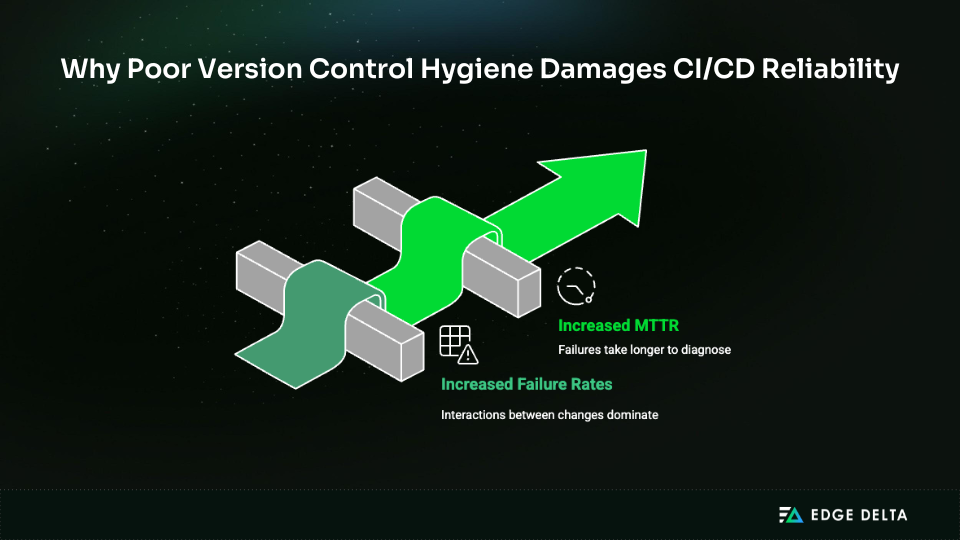
How Merge Hell Increases CI Failure Rates
When many changes land together, failures become more frequent and less predictable. Interactions between changes dominate, making failures harder to explain. Over time, trust in CI erodes, and safeguards are bypassed.
How Merge Hell Increases MTTR
Failures involving multiple interacting changes take longer to diagnose. Engineers must separate several causes at once, increasing mean time to recovery and slowing delivery across the system.
Why Version Control Hygiene Is a Systems Problem, Not a Git Problem
It is easy to frame merge hell as a Git usage issue, but that framing overlooks the structural forces that shape behavior.
Version control hygiene emerges from incentives, automation, and feedback loops that shape how teams surface, prioritize, and act on operational signals. CI/CD systems influence all three.
When systems make divergence expensive and early integration unavoidable, hygiene improves without relying on individual discipline.
Conclusion
Merge hell is not random. It is the predictable result of prolonged divergence, deferred integration, and weak system-level enforcement. CI/CD pipelines simply expose these conditions by testing the system as it actually exists rather than as individual branches assume it to be.
Maintaining version control hygiene requires workflows where integration happens continuously, remains inexpensive, and is enforced by the system. When cleanliness is treated as an architectural issue rather than a behavioral one, merge hell becomes far less common.
Frequently Asked Questions
What Is Version Control Hygiene in CI/CD?
It is the set of system-level practices that keep integration predictable in CI/CD pipelines. Hygiene controls branch lifetime, change size, and integration timing so pipelines validate the combined system instead of isolated changes.
What Causes Merge Hell in CI/CD Pipelines?
When divergence builds up over time through long-lived branches, big modifications, and slow integration, merge hell happens. CI/CD pipelines show similar problems when a lot of assumptions clash at once, which is commonly when enforcement isn’t very strong.
How Can CI/CD Systems Help Prevent Merge Hell?
CI/CD systems prevent merge hell by enforcing up-to-date branches, validating against the mainline, and blocking broken integrations. This keeps the merge cost bounded by forcing reconciliation early and continuously.
Why Are Long-Lived Branches Risky?
Long-lived branches allow assumptions to drift as the mainline evolves independently. Even without direct code conflicts, system-level incompatibilities accumulate, making integration failures harder to diagnose and resolve.
How Does Version Control Hygiene Affect Delivery Reliability?
Good hygiene reduces CI failure rates and shortens recovery time by limiting how many changes interact at once. Poor hygiene increases failure ambiguity, erodes trust in CI/CD, and destabilizes delivery flow.
Sources
- Martin Fowler – Continuous Integration
- Martin Fowler – Branching Patterns
- ThoughtWorks – Continuous Integration Anti-Patterns
- DORA – Accelerate State Of DevOps Research
- Google SRE Book – Monitoring Distributed Systems
- Google SRE Book – Effective Troubleshooting
- ACM Queue – Systems Thinking In Software Engineering